Wednesday, 17 February 2010

Updated two-round mock draft: 17th February

By Rob Staton
For the first time I have included a full second round projection. The scouting combine is a week away so it'll be interesting to see how projections shift following events in Indianapolis. Perhaps equally important though is the beginning of free agency and the trade window re-opening on March 5th. Free agency itself will be stagnated and largely uneventful, but we could see some trades with teams trying to make moves to compensate for a lack of options outside of the draft. The one issue that could affect things more than anything else is what St. Louis do at the quarterback position. Are they serious about Michael Vick? Some reports suggest they are. However, if they enter draft week without a legitimate option at quarterback - they almost certainly have to explore that position with the #1 pick.

When compiling a mock draft - the question is whether you assume they'll find a quaterback before April 22nd and give them Ndamukong Suh or Gerald McCoy? Until the Rams can find a legitimate option at quarterback, they'll continue to struggle. They've gone down the 'safer' lineman option in the last three drafts and struggled. It's time to find a quarterback. Sam Bradford or Jimmy Clausen aren't the top two prospects in this draft, but then Matt Stafford wasn't necessarily the best player available last year either. The question perhaps shouldn't be whether Suh or McCoy go first overall - but Bradford or Clausen.

I have the Seahawks taking an offensive prospect at #6, #14 and #40 in this draft. Could it happen? There's no doubt a lot of strength on defense in the 2010 class, but each of the selections made on offense offer value here. Despite the needs on the defensive line and secondary, most of the repair work for Pete Carroll and co rests on offense. In this latest projection I wanted to represent the possibility of the Seahawks investing in the future of their offense. Don't forget to leave your thoughts in the comments section at the bottom of the article.


Round One


#1 St. Louis: Sam Bradford (QB, Oklahoma)
The Rams could trade for Michael Vick. They might trade for someone else. Either way - they don't enter 2010 without a new quarterback. Suh and McCoy might be BPA - but this is a quarterback's league.


#2 Detroit: Gerald McCoy (DT, Oklahoma)
The Lions would salivate over the prospect of having to choose between Suh and McCoy. McCoy gets the nod here simply because he's quicker and more disruptive up the middle.


#3 Tampa Bay: Ndamukong Suh (DT, Nebraska)
If the top two defensive tackles leave the board before this pick, projecting which direction the Buccs go will be a complete lottery. If the Rams take a quarterback, it appears likely the top two defensive tackles will go #2 and #3.


#4 Washington: Anthony Davis (OT, Rutgers)
Consensus opinion appears to be that this pick will be a quarterback or an offensive tackle. Jason Campbell might get a year to prove himself on a high tender. There are some character and attitude question marks surrounding Davis - he needs to interview well in Indianapolis.


#5 Kansas City: Rolando McClain (LB, Alabama)
The Chiefs are committed to creating a strong 3-4 defense but lack that presence at inside linebacker. McClain can be an impact player for Kansas City.


#6 Seattle: Jimmy Clausen (QB, Notre Dame)
I've voiced concerns about Clausen and they still remain. However, it'd be ignorant to only look at the negative possibilities such as a dramatic fall down the board. The Seahawks need a long term answer at the position with Matt Hasselbeck in a contract year.


#7 Cleveland: C.J. Spiller (RB, Clemson)
In a draft with only a handful of pure offensive playmakers, Spiller's name could get called early. The Browns needs someone like this.


#8 Oakland: Jason Pierre-Paul (DE, USF)
We know how Al Davis' drafts. The three prospects to keep an eye on - JPP, Bruce Campbell and Taylor Mays. All expected to run fast time at the combine and flash the physical qualities Davis looks for.


#9 Buffalo: Bryan Bulaga (OT, Iowa)
The Bills need to improve their offensive line. Bulaga will interest teams as a left tackle, but like Jake Long he could be an all-pro on the right hand side.


#10 Jacksonville: Joe Haden (CB, Florida)
The Jaguars are rebuilding their secondary and keeping Haden in Florida would be a popular move.


#11 Denver: Carlos Dunlap (DE, Florida)
Dunalp's size makes him a perfect option at five technique end in the Broncos 3-4.


#12 Miami: Dan Williams (DT, Tennessee)
Williams' ability to play the coveted 3-4 nose tackle position will make him a desirable pick for teams using the scheme.


#13 San Francisco: Eric Berry (S, Tennessee)
The 49ers will explore the possibility of adding a playmaker to their secondary. If Berry is available here, he's the obvious choice.


#14 Seattle: Dez Bryant (WR, Oklahoma State)
Brian Price and Derrick Morgan make sense, but so does Dez Bryant. There's no guarantee Nate Burleson and Deion Branch return in 2010 and the Seahawks need a playmaker. I have Russell Okung falling.


#15 New York Giants: Derrick Morgan (DE, Georgia Tech)
Morgan has great potential, but amongst the cluster of 3-4 teams and alternative picks - he might suffer a slight fall on draft day. This would be a perfect fit for both prospect and team.


#16 San Francisco: Trent Williams (OT, Oklahoma)
Williams' unconvincing displays at left tackle in 2009 will stop him going much earlier than this. The 49ers - looking for a book end for Joe Staley - could see value in the Sooners lineman here.


#17 Tennessee: Brian Price (DT, UCLA)
The Titans are another team who will likely look to upgrade their defensive line. Price is a penetrative interior force.


#18 Pittsburgh: Taylor Mays (S, USC)
This is one of the few places Mays could go and have a real impact. Playing behind a good pass rushing defense, Mays and fellow Trojan Troy Polamalu could create the most intimidating secondary combo in the NFL.


#19 Atlanta: Kareem Jackson (CB, Alabama)
What price a trade with Jacksonville to take Joe Haden? Jackson's stock will rise after the combine and he could go higher than this.


#20 Houston: Earl Thomas (S, Texas)
The Texans' would like one of the top ranked right tackles to fall here, but they also need a playmaker in the secondary. Thomas could convert to cornerback and would be a popular choice in Houston.


#21 Cincinnati: Arrelious Benn (WR, Illinois)
Bad quarterback play and inconsistent hands has hurt Benn's stock, but this is still a guy touted as a top 15 pick at the start of the year. A tight end like Jermaine Gresham is also a possibility.


#22 New England: Jared Odrick (DT, Penn State)
The Patriots are in the process of major changes on their defensive line. Drafting the versatile Odrick gives New England some options long term.


#23 Green Bay: Russell Okung (OT, Oklahoma State)
Kyle Rota's scouting report on Okung is an absolute must read and highlights some of the reasons why Okung might not be a top ten lock. He would've been a late first round pick as an underclassmen, nothing this year has proved otherwise in my opinion.


#24 Philadelphia: Everson Griffen (DE, USC)
The Eagles need a better pass rush, that was evident in their playoff defeat at Dallas. Griffen's stock is difficult to project, he could rise up the boards with an impressive combine.


#25 Baltimore: Jermaine Gresham (TE, Oklahoma)
The Ravens always find value in the draft. Gresham, as a quality pass-catching tight end, offers greater value than the receivers on offer this late in round one.


#26 Arizona: Ricky Sapp (LB, Clemson)
Arizona are still piecing together their 3-4 scheme and Sapp could be a stand out OLB.


#27 Dallas: Kyle Wilson (CB, Boise State)
The Cowboys would like to add a playmaker to their secondary. Wilson would also double up as a return specialist.


#28 San Diego: Brandon Graham (DE, Michigan)
Graham is flexible enough to play in either the 4-3 or the 3-4. San Diego could use another pass rusher off the edge and Graham is par value here.


#29 New York Jets: Devin McCourty (CB, Rutgers)
Rex Ryan loves to draft for his secondary. The Jets own one lockdown corner, shutting down the other side and combining it with the team's pass rush will make the Jets very difficult to beat.


#30 Minnesota: Dominique Franks (CB, Oklahoma)
We could see a run on cornerbacks in the late first round. The Vikings could use an upgrade in the secondary. Lamarr Houston (DT, Texas) is an alternative option.


#31 Indianapolis: Sean Weatherspoon (LB, Missouri)
Watching tape of Missouri, I was never blown away by Weatherspoon. He put in an eye catching display at the Senior Bowl, however, and some teams will appreciate his athleticism and ability to start as a rookie.


#32 New Orleans: Sergio Kindle (LB, Texas)
The Saints could use Kindle creatively, as a linebacker most of the time but an edge rush on passing third downs.


Round Two


#33 St. Louis - Brandon LaFell (WR, LSU)
Having found their franchise quarterback in round one, the Rams find a potential #1 receiver.


#34 Detroit - Jahvid Best (RB, California)
The Lions need more explosion at running back. Concerns about his durability push Best into round two.


#35 Tampa Bay - Damian Williams (WR, USC)
The Buccs need to get some weapons for Josh Freeman. Williams is already a very smooth receiver, but he needs to make less catches with his body.


#36 Kansas City - Cam Thomas (DT, North Carolina)
The Chiefs continue their commitment towards building a strong 3-4 defense by finding a nose tackle.


#37 Washington - Mike Iupati (OG, Idaho)
The Redskins complete the new left side of their offensive line with the talented Iupati.


#38 Cleveland - Eric Decker (WR, Minnesota)
Browns GM Tom Heckert watched Decker personally on a few occasions in 2009. Coming from Philly, he understands the true value of having playmakers on offense.


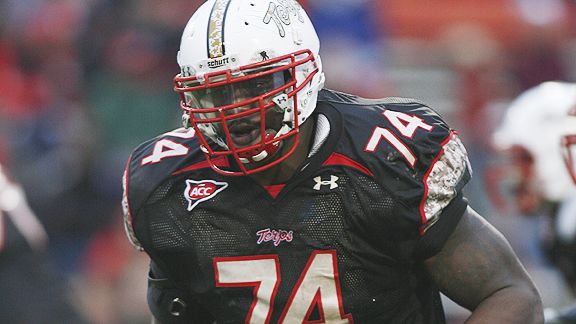
#39 Oakland - Bruce Campbell (OT, Maryland)
Campbell's injury concerns push him into round two here. Oakland could trade up to secure him earlier.


#40 Seattle - Charles Brown (OT, USC)
The perfect fit for Alex Gibbs' scheme and someone Pete Carroll is very familiar with.


#41 Buffalo - Rob Gronkowski (TE, Arizona)
Chan Gailey needs a good blocking tight end for his offense.


#42 Tampa Bay - Demaryius Thomas (WR, Georgia Tech)
The Buccs spend back-to-back picks on weapons for Josh Freeman.


#43 Miami - Brandon Spikes (LB, Florida)
The Dolphins need an inside presence.


#44 New England - Alex Carrington (DE, Arkansas State)
Having accumulated second round picks, the Pats continue to add to their defensive line.


#45 Denver - Maurkice Pouncey (C, Florida)
The Broncos need a center and Pouncey is par value.


#46 New York Giants - Chad Jones (S, LSU)
Regardless of concerns for Kenny Phillips' return, the Giants could use Jones' size in their secondary.


#47 New England - Aaron Hernandez (TE, Florida)
Tom Brady would love throwing to Hernandez.


#48 Carolina - Lamarr Houston (DT, Texas)
Houston could go in round one if there's an early rush on defensive tackles.


#49 San Francisco - Jerry Hughes (DE, TCU)
Hughes did a great job for TCU in 2009, but opinion is mixed on his pro-prospects.


#50 Kansas City - Vladimir Ducasse (OT, UMass)
The UMass lineman might end up as a guard.


#51 Houston - Anthony Dixon (RB, Miss State)
I rank Jonathan Dwyer and Ryan Matthews in the 3-4 round range. Dixon is a pure power back, Dwyer is not.


#52 Pittsburgh - Perrish Cox (CB, Oklahoma State)
The Steelers might look to add a cornerback and Cox is worth the 52nd overall pick.


#53 New England - Sean Lee (LB, Penn State)
The Pats will look to bring in a linebacker to play alongside Mayo.


#54 Cincinnati - Corey Wooten (DE, Northwestern)
Wooten is flexible enough to play the five technique due to his size, so could go earlier.


#55 Philadelphia - Nate Allen (S, Georgia Tech)
The Eagles need a safety, although this might be half a round too early for Allen.


#56 Green Bay - Donovan Warren (CB, Michigan)
Warren's stock is mixed. Some rank him as a first round pick.


#57 Baltimore - Brandon Ghee (CB, Wake Forest)
Ghee would fit in very nicely to Baltimore's defense.


#58 Arizona - Jared Veldheer (OT, Hillsdale)
Veldheer's stock is rising after performing well in the Texas vs the nation game.


#59 Dallas - Jordan Shipley (WR, Texas)
Pure Jerry Jones style pick.


#60 San Diego - Joe McKnight (RB, USC)
McKnight is my third favorite running back in this class. Again, I have a team passing on Dwyer and Matthews.


#61 New York - Jason Worilds (DE, Virginia Tech)
Another excellent pass rusher for the Jets defense.


#62 Minnesota - Tsyon Alualu (DE, California)
The Vikings will consider adding a defensive lineman.


#63 Indianapolis - Mike Neal (DT, Purdue)
Not the biggest guy, but that's how Indy like them.


#64 New Orleans - Golden Tate (WR, Notre Dame)
I don't buy talk of Tate going in round one or even the early second round.

Tuesday, 16 February 2010

Kiper, McShay on running backs

POTD: CJ Spiller, RB, Clemson


By Kip Earlywine

Height: 5'11"
Weight: 195 lbs.
Unofficial 40: 4.34


Positives:

  • Very Fast
  • Great moves, can start/stop and change directions especially well
  • Above average running instincts
  • 2009 was not a fluke, he produced in '08, '07, and '06
  • Plays hurt... plays well hurt
  • Dangerous kick returner
  • Very good outside runner
  • Solid Burst
  • Seems like a leader and has no character issues
  • Career 1 TD per ~20 carries, most of them big plays
  • Reminds me of Reggie Bush as a receiver (that's a huge compliment)

Negatives:

  • Not much untapped potential, size looks maxed out
  • Size/durability probably means he'll continue to be a 150-200 carry RB
  • Not a particularly good inside runner or goal line RB
  • Not especially powerful
  • Supposedly (I've read) is mediocre as a blocker

Sound Bites:
"Spiller is the most electrifying player in college football today."

-Todd McShay

My thoughts:

As always, the POTD series is an incomplete analysis that serves more as a preview than a final word. Spiller is the first RB I've done in this exercise, and I have to say that RB might be the most difficult position to evaluate simply from highlights. Even good sites like prodraftparty show very little pass protection, and we don't see runs where the back missed a hole and settled for 1 yard and a cloud of dust. If it looks like the Seahawks get serious about Spiller, I'll have to get some real game tape of him in a couple months to give a much more accurate opinion.

Anyway, Spiller is an exciting player. Clemson is not a particularly good team, but they were at times a top 25 ranked one during this last season. I firmly believe that without Spiller, they never would have been. Its not very often you see a RB that is the team by himself (like Jake Locker is for UW), and for Spiller to have that kind of impact when averaging only 14.5 carries a game, is ridiculous. He might not carry the ball much, but he chipped in 2.3 catches a game and also returns kickoffs extremely well.

My big concern for Spiller is that like Reggie Bush, he's more of a "kick it outside" runner, and the zone scheme really emphasizes inside running (man does too, just a little less). As an inside runner, Spiller is (edit- reworded) not nearly as potent. And since Seattle's tackles suck and Carlson is a mediocre blocker, I don't see a lot of promise for designed outside rushes (that was an area Seattle really sucked at last year). Bush is a very common comparison to Spiller, and Bush averaged under 4 ypc every year until the Saints made a Superbowl run. Obviously, the Seahawks are very far away from having a Superbowl contending team. Spiller is awesome, and he gives the Seahawks something they badly need as a big play runner and KR, but if the Hawks draft him and he's a dud for us, it wouldn't completely shock me. I don't want to sound too negative though- Spiller is easily the best RB in the draft and I'd probably take him over any RB in last year's draft as well.

Assuming that the Seahawks manage to get the most out of Spiller and he's every bit as dominant in the pros as he was in college, he'd still be seeing less than 20 total touches a game, and how much do you pay for that? Is <20 touches a game worth $8-9 million per year? Probably not. However, at #14, his contract would be much more reasonable, somewhere around $3 million per.

Alex Gibbs turned Davis, Anderson, and Gary into huge stars, and the highest draft pick of the bunch was a 4th rounder. With what looks to be a decently deep RB class, will Seattle invest a big high pick for a RB? Or will they trust Gibbs track record and get a bargain RB later on while spending that pick to grab a WR, DT, or OL instead of Spiller?

Monday, 15 February 2010

Hate mail

By Rob Staton
One of the main reasons I started Seahawks Draft Blog was to interact with fellow Seahawks fans and have a forum where the draft can be debated, reviewed, dissected and discussed. Disagreement is a part of life and I'm not beyond criticism, so I wanted to publish an email I received today:

"Did you personally pick Clausen and a DE?

If so you're a complete idiot and you belong in the Ruskell era.

Not only was Matt killed this year by the pass rush, but our running game sucked and Jones announced his retirement. If you don't think they are taking an O Lineman with one of those top 2 picks, you are beyond lost.

I would strongly consider taking two O lineman if I was Schneider. Thats how important O line is. You get a decent O line, and suddenly Forsett and Matt are total studs, and the whole defense is better because the offense doesnt 3 and out 50% of the time leaving the D breathless.

You don't deserve to have your own Seahawks mock draft blog page. Thats the problem with the internet. Any idiot can post whateevr unsubstantiated claim they want. I just didnt think my Seahawks brothers were part of the problem. Move to San Fran, we don't want you."


I think it's a valid point that clearly the Seahawks offensive line has been a cause for concern ever since the Super Bowl run. Losing the best interior lineman in the NFL in such unusual circumstances was never forgotten during the Ruskell era. More to the point, Hutchinson was never truly replaced. The move from Robbie Tobeck to Chris Spencer has been difficult, largely due to injuries to Spencer but also inconsistent play. This led to the team drafting Max Unger last year and eventually starting him at center.

Replacing Walter Jones was always a pressing concern that became closer with every passing year. That has become a reality now. Sean Locklear has not convinced anyone he deserves to be a permanent feature at left tackle and has missed games through injury himself.

In 2007, Matt Hasselbeck carried the line and the stagnant running game on his back with the best season statistically of his career. In 2008 and 2009, injuries to Hasselbeck and a loss of playmaking options exposed the frailties of the line. One of the first things Pete Carroll did upon accepting the gig in Seattle was to approach Alex Gibbs to be part of his coaching staff - a noticeable appreciation of the situation.

Because of this, as the emailer correctly points out the opportunity to draft an offensive tackle in round one must be considered. However, allow me to point out why this may not be the case also. The first issue is the fact this isn't a great draft for offensive tackles. There are some that will go in round one and some that will go earlier than perhaps they should. Such is the modern NFL and the premium upon the position. What it does mean though is that the quicker tackles leave the board, the greater the possibility the Seahawks end up over drafting. That may be necessary. At the same time, it could be true that 1-2 tackles have left the board before the 6th overall pick and 3-4 by the #14 selection. Do you ignore greater talent elsewhere on a roster with many holes just to fill one specific area?

Secondly, Alex Gibbs-coached teams traditionally haven't drafted lineman early. Houston taking Duane Brown in 2008 is more of an exception than the norm. The need in Seattle might be greater than previous situations Gibbs has faced. What hasn't changed however is his philosophy which favors agile, smaller lineman who can work in a zone blocking scheme. Unfortunately, this isn't a draft filled with that type of offensive tackle.

Anthony Davis isn't an obvious fit for the zone scheme, as I suggested in a scouting report on the Rutgers left tackle back in November. Russell Okung (OT, Oklahoma State) is a more suitable candidate, but I tend to agree with resident scout Kyle Rota's synopsis on the Cowboys lineman. Bryan Bulaga played in a variation of the zone scheme in Iowa. I do believe though that his greatest value at the next level will be as a right tackle. He can play the blind side, but he will be a significantly better pro when he hasn't got to deal with elite edge rushers (he can struggle against speed) and can get some tight end support in the running game. Trent Williams (OT, Oklahoma) is strictly a right tackle and Bruce Campbell (OT, Maryland) owns immense physical qualities - but also a poor injury record.

The most likely candidate for the Gibbs zone blocking scheme would appear to be Charles Brown (my report here) - a prospect familiar to Carroll as he played his college ball at USC. He has the right kind of size (290lbs) and above average ability as a converted tight end. He's a smart player (important in the ZBS) with plenty of starting experience. He has a good hand punch and is a capable pass protector. His size won't interest most teams unless he can get up to the 310lbs range for the combine next week. This could push him into the second round where I projected he would be taken by the Seahawks in my last mock draft.

There are other possibilities too. A prospect like Jason Fox (OT, Miami) would fit the Gibbs mantra and likely be available later on. Selvish Capers (OT, West Virginia) is another name to monitor. Clearly there are options for the new regime if they did want to take advantage of a strong defensive line class in round one or draft the teams future franchise quarterback.

I also believe - and this is merely my own personal opinion - that an offensive line containing first round picks is not a necessity for success. You only have to look at the Super Bowl - two teams that didn't own a cluster of early round picks on their offensive line and both sporting dominant passing attacks. I've voiced many times that whilst the offensive line could do with some investment, an expensive rookie will struggle to block two guys off the edge as much as Sean Locklear. Too often in the last two years a lack of threat at running back, receiver and yes - quarterback - has allowed teams to blitz heavily against the pass and stack the box against the run. They've dared Seattle to beat them and they haven't been able to. At least not against any team not based in St. Louis.

Until Seattle's offense demands respect, it won't receive any. For me, investing in a better offensive line will only lead to long term success if it coincides with better playmakers being brought in at running back and receiver - with a legitimate long term plan at quarterback. That's how you keep a defense honest. For those reasons I think it's unlikely the Seahawks will spend both first round picks on offensive lineman. But I'm not ignorant to the fact it's also a vital need and even despite the appointment of a legendary line coach - one high pick on a future left tackle is absolutely plausible.

Mel Kiper and Todd McShay in the lab

Combine ready: Clausen, Mays, Spiller et al

Sunday, 14 February 2010

Long term vs Short term

By Rob Staton
Long term thinking or a short term shot in the arm? Do you use the 2010 draft to plan ahead or do you use it to enhance what you already have and try to get an immediate boost? Is it a combination of the two or can you not afford to think like this - is it too manufactured when a draft board needs to be respected purely based on BPA? What are the potential pitfalls of either?

Let's say the Seahawks go quarterback and left tackle in round one. This would very much be a long term solution, building an offensive core for tomorrow. However, Pete Carroll's new regime would also be left facing a 2010 season that could potentially be described as a 'lame duck'. A holding position until the rookie's are ready. Current starters at either position would be left holding the fort - and it could lead to disharmony between the present and the future. Even if everyone acted very professional about the situation, you'd be asking the same troops who struggled in 2009 to suddenly produce the goods if you wanted to enjoy a competitive season upon your (Carroll's) return to the NFL.

Of course, even taking that into account, the long term benefit that there's a direction when ageing veterans do retire - is huge. The old adage goes, "fail to prepare and be prepared to fail." The Seahawks have to embrace that the Hasselbeck/Jones/Alexander era will soon be a distant (yet fond) memory. Finding the next batch of franchise players and preparing them sufficiently would likely be welcomed by fans, pundits and coaches alike.

The short term solution doesn't possess that kind of support. It's often seen as the quick-fix. Drafting a running back early has it benefits in that there's a short learning curve - and the Seahawks do need a running back. However, it's unlikely to win you a post season berth consistently if you continue to neglect key positions that may need a year or two to develop and prosper.

Having said that - if the Seahawks want to avoid another bitterly disappointing season in the mold of 2008/2009, they have to find some form of immediate contribution. Whether that's a pass rusher who can finally get to the quarterback, a running back capable of keeping a defense honest or a wide out who gives Matt Hasselbeck a true #1 threat. Transitioning from one era to another needs to be planned with tomorrow in mind - but introducing inexperienced young men into a losing culture is never a good idea.

These are all questions facing Pete Carroll and his new regime. If he were to draft Jimmy Clausen at #6 and Bryan Bulaga at #14, many would rejoice at locking up two key positions for the future (quarterback and offensive tackle). However, would these same fans remain supportive if the Seahawks struggled to another 4-5 win season? What impact would drafting those prospects have on incumbent starters like Matt Hasselbeck and harmony between currents veterans and the younger future?

If the new regime decided to draft Derrick Morgan and C.J. Spiller, some fans would (perhaps correctly) ask where is the long term planning? What is the plan post-Hasselbeck considering his contract year status and age? But would these same fans not appreciate it if the more short term thinking got the new coaching staff up and running on the front foot, creating a platform for younger prospects to brought in perhaps in a better (winning?) culture and atmosphere?

Not that a plan like this was ever likely to be formed, but if you draft one pick for the future and one for tomorrow - do you run the risk of making a token effort that really neither does enough for the future nor enough to win now?

Ultimately decisions will be made based on talent and how the front office set up their draft board. But if there are prospects bunched together of a similar grading, this short or long term thinking could become a discussion point. What do you think the Seahawks have to consider going into this crucial draft for the franchise? Let me know in the comments section.

Saturday, 13 February 2010

POTD: Bruce Campbell, T, Maryland


By Kip Earlywine

Height: 6'7"
Weight: 310 lbs.
Unofficial 40: 4.94


Positives:

  • Prototypical size (and could add more)
  • Probably the most athletic tackle in the draft
  • Sub-5 40, fast, agile
  • Natural, comfortable, polished, instinctive
  • Does a wonderful job squaring and staying square with pass rushers
  • Above average run blocker
  • Near elite pass blocker
  • Monster Potential
  • Could excel in zone or man
  • No off the field issues that I could find

Negatives:

  • Injuries, injuries, injuries
  • Deceptive footwork? Is a little slow vs. inside moves

Sound bites:


"Consider Bruce Campbell the Jason Smith of the 2010 NFL Draft class. His stock will be soaring through the roof once we get to the Combine, however, he is more of a natural pass protector than Smith."

-Matt McGuire (Walter Football)

"Campbell is just as -- if not more -- adept at guarding the blindside as [Anthony Davis and Trent Williams] and there is every reason to think he could develop into a dominant NFL run blocker."

-KC Joyner, (draft lab series)

My thoughts:

Campbell is my favorite player in the entire draft that I don't want the Seahawks to touch with a 10-foot pole. He's had so many injuries its just ridiculous, in 3 college seasons he only totaled 17 combined starts and 21 total appearances. He did stay healthy in 2008, starting all 13 games, but suffered from turf toe and even an MCL in 2009 and pretty much didn't do anything last year. I've played with two turf toes and two sprained wrists all at once, injuries like those are not to be taken lightly and have a huge impact especially in the running game. Thankfully, they are largely preventable if a player always tapes up before every practice. I think after experiencing turf toe hell, Campbell will probably take more measures to prevent his next one, but the MCL is a bit more concerning. Knee injuries are one of the biggest career destroyers for linemen on both sides of the ball. Once you can't trust your knee anymore, you lose the power to drive block and you are forced to play careful instead of all-out. Campbell may recover from his MCL just fine, but the potential downside makes selecting him in the top 10 a huge risk.

Now that that's out of the way, its really too bad that Campbell has had those injuries, because I loved watching footage of him. He's the best tackle I've previewed so far at squaring his body with the defensive end and keeping the rusher from rushing around or inside him. He's strong enough that bull-rushing him is a waste of time, and he simply won't be beaten outside. His footwork doesn't look that good to me, which is weird considering he's such a freak athlete and is extremely good at staying centered on pass rushers which is much harder than it looks. Sometimes a rusher will make a nice inside move and Campbell almost looks like he's wearing concrete boots. Many experts rave about Campbell's footwork though and I'll definitely say this- I won't argue with the results. If he's that good at staying on top of defenders in pass pro and keeping up on edge rushes, then obviously he's doing something very right.

Campbell is a solidly above average run blocker as well, and usually you don't find tackles that are so good at both pass pro and run blocking.

Campbell's speed and athleticism could make his stock rocket at the combine. He could very well be a top 10 pick. If he had been healthy at Maryland, he'd probably be a lock in the top 5.

For me, he's just too risky. Especially since Gibbs has a penchant for finding good starters much later. But I do like him a lot, and if he stays healthy, I think he has a great chance of being a future pro-bowler.