By Rob Staton
Mel Kiper and Todd McShay discuss draft matters in their first podcast of the year. This will become a weekly series, published on Wednesday's. Included in this edition - a debate about Jimmy Clausen's prospects and a look at each pundit's big boards.
Todd McShay also has written the second edition of his mock draft. He has the Seahawks taking Bryan Bulaga (OT, Iowa) at #6 and C.J. Spiller (RB, Clemson) at #14. I haven't seen Bulaga as high as that in any other mock draft so far.
Walter Cherepinsky also thinks the Seahawks will draft Bulaga, but with the 14th overall pick. He has the new regime drafting Eric Berry (S, Tennessee) at #6. If the Seahawks did draft Berry that early, they'd have over $150m tied up at the safety and linebacker positions.
Chad Reuter publishes a new mock draft on CBS Sportsline, with the Seahawks taking Dez Bryant and Anthony Davis. I would be surprised with the Davis pick - he might have Ryan Clady-type potential (and Clady worked in a ZBS at Denver) but he's not the prototype Alex Gibbs lineman.
Wes Bunting at the National Football Post also puts out his first mock of the year. The Seahawks take Eric Berry and Jonathan Dwyer. I will be absolutely stunned if Dwyer a.) goes in round one and b.) it's the Seahawks who take him. Alex Gibbs running teams don't draft running backs in the top fifteen. I'm not a fan of Dwyer's - for me he's a third or fourth round pick.
Mocking the draft has a scouting report on Florida defensive end Carlops Dunlap: "The physical tool set that he brings to the table is as good as it gets and any defensive line coach that is confident in their ability to get the most out of a player will drool over Dunlap’s potential. Dunlap has shown flashes of being unblockable, but those kinds of performances were too few and far between."
Draft Tek and it's sophisticated software has a new consensus mock draft. The Seahawks select Joe Haden and Derrick Morgan with their first two picks and running back Jahvid Best in the second round.
Don't forget to check out my latest mock draft, updated yesterday.

Thursday, 11 February 2010


Wednesday, 10 February 2010
Updated mock draft: 10th February
By Rob Staton
We now know the complete draft order for 2010 and the scouting combine is a fortnight away. Finding an offensive playmaker will be difficult for the Seahawks in 2010. Free agency offers slim pickings, whilst trading for a walking soap opera like Brandon Marshall comes with it's own pitfalls - not to mention an expensive bounty. This isn't a draft filled with options either. If the Seahawks want to add a weapon on offense, they might have to bite the bullet early.
It's ambitious to believe Seattle's issues on offense will be solved by a rookie left tackle. That simply isn't the case. An upgrade would be desirable, but it won't stop a team stacking the box against the run or showing a heavy blitz on passing downs. Until the Seahawks offense demands respect, it won't receive any. The NFL has become a passing league - the two Super Bowl teams this year have shown what a top rated passing offense can bring. This mock draft looks at a scenario the new regime in Seattle might entertain. I've also included the first ten picks of the second round for the first time, to include Seattle's third pick in the top forty selections. I will expand to a full two-round mock after the combine.

#1 St. Louis: Gerald McCoy (DT, Oklahoma)
Could the Rams select McCoy ahead of Ndamukong Suh? Absolutely. There's very little separating the two top prospects in this year's class. Suh has been considered a shoe in first overall, but don't count out McCoy or one of the quarterbacks.

#2 Detroit: Ndamukong Suh (DT, Nebraska)
If the Rams select McCoy, the Lions will almost certainly draft Suh. Jim Schwartz had a lot of success as a defensive coordinator in Tennessee thanks to an elite defensive tackle.

#3 Tampa Bay: Jason Pierre-Paul (DE, USF)
Pierre-Paul is an explosive, raw talent. He could light up the combine. Naturally gifted with limitless potential - don't be surprised if he starts appearing in the top five in a lot more mocks.

#4 Washington: Sam Bradford (QB, Oklahoma)
If Bradford can work out and convince scouts about his durability, he's a candidate to go first overall. Washington could maintain Jason Campbell's place on the roster until Bradford is ready to start.

#5 Kansas City: Rolando McClain (LB, Alabama)
The Chiefs are committed to creating a strong 3-4 defense but lack that presence at inside linebacker. McClain can be an impact player for Kansas City.

#6 Seattle: Dez Bryant (WR, Oklahoma)
Bryant needs to prove the year off hasn't had a negative effect on his physical condition. The Seahawks need a productive weapon on offense.

#7 Cleveland: C.J. Spiller (RB, Clemson)
In a draft with only a handful of pure offensive playmakers, Spiller's name could get called early. The Browns needs someone like this.

#8 Oakland: Bruce Campbell (OT, Maryland)
We know how Al Davis' drafts by now. Campbell will bench a ton and run a great forty time at the combine - he's been described by one coach as the offensive tackle version of Vernon Davis.

#9 Buffalo: Anthony Davis (OT, Rutgers)
Call this a hunch, but I don't expect Chan Gailey to fall for Jimmy Clausen. Offensive tackle is a huge hole in Buffalo and Davis would certainly fill it.

#10 Jacksonville: Joe Haden (CB, Florida)
If the Jags really are sold on Tebow-for-tickets, they could trade down here dramatically. I can't see another team who would usurp them until round two - so why not aid that secondary rebuild with another Gator?

#11 Denver: Carlos Dunlap (DE, Florida)
Dunalp's size makes him a perfect option at five technique end in the Broncos 3-4.

#12 Miami: Eric Berry (S, Tennessee)
The Dolphins invested two high picks in their secondary last year, but Berry would further compliment Miami's defense.

#13 San Francisco: Dan Williams (DT, Tennessee)
Williams has performed well in Mobile. Expect a run on the top defensive lineman early in round one - Williams is the best nose tackle prospect for 3-4 teams.
#14 Seattle: Brian Price (DT, UCLA)
Pete Carroll might look for a dominant interior presence to draw attention away from the edge rush. The run on top defensive lineman continues with Price adding a nice compliment to Brandon Mebane.

#15 New York Giants: Derrick Morgan (DE, Georgia Tech)
Morgan has great potential, but amongst the cluster of 3-4 teams and alternative picks - he might suffer a slight fall on draft day. This would be a perfect fit for both prospect and team.
#16 San Francisco: Bryan Bulaga (OT, Iowa)
With Joe Staley entrenched at left tackle, the 49ers could use one of their first round picks on a bookend. Bulaga could be an All-pro on the right side.

#17 Tennessee: Lamarr Houston (DT, Texas)
Another team with a need on the defensive line who might take advantage of a deep class. Houston's stock is soaring - he was great in the BCS Championship - and he could be a first round pick.

#18 Pittsburgh: Taylor Mays (S, USC)
This is one of the few places Mays could go and have a real impact. Playing behind a good pass rushing defense, Mays and fellow Trojan Troy Polamalu could create the most intimidating secondary combo in the NFL.

#19 Atlanta: Kareem Jackson (CB, Alabama)
What price a trade with Jacksonville to take Joe Haden? Jackson's stock will rise after the combine and he could go higher than this.

#20 Houston: Trent Williams (OT, Oklahoma)
The Texans' biggest need is improving their offensive line and Williams provides a nice right side option.

#21 Cincinnati: Arrelious Benn (WR, Illinois)
Bad quarterback play and inconsistent hands has hurt Benn's stock, but this is still a guy touted as a top 15 pick at the start of the year. A tight end like Jermaine Gresham is also a possibility.

#22 New England: Jared Odrick (DT, Penn State)
The Patriots are in the process of major changes on their defensive line. Drafting the versatile Odrick gives New England some options long term.

#23 Green Bay: Russell Okung (OT, Oklahoma State)
Kyle Rota's scouting report on Okung is an absolute must read and highlights some of the reasons why Okung might not be a top ten lock. He would've been a late first round pick as an underclassmen, nothing this year has proved otherwise in my opinion.

#24 Philadelphia: Everson Griffen (DE, USC)
The Eagles need a better pass rush, that was evident in their playoff defeat at Dallas. Griffen's stock is difficult to project, he could rise up the boards with an impressive combine.

#25 Baltimore: Jermaine Gresham (TE, Oklahoma)
The Ravens always find value in the draft. Gresham, as a quality pass-catching tight end, offers greater value than the receivers on offer this late in round one.

#26 Arizona: Ricky Sapp (LB, Clemson)
Arizona are still piecing together their 3-4 scheme and Sapp could be a stand out OLB.

#27 Dallas: Earl Thomas (S, Texas)
The Cowboys can look at this scenario from a position of strength. Thomas is a local product that offers playmaking potential in the secondary.

#28 San Diego: Brandon Graham (DE, Michigan)
Graham is flexible enough to play in either the 4-3 or the 3-4. San Diego could use another pass rusher off the edge and Graham is par value here.

#29 New York Jets: Kyle Wilson (CB, Boise State)
The Jets own one of the standout cornerbacks in the NFL, but you can never have too much of a good thing. Alongside Rex Ryan's always competitive pass rush, the Jets would own a solid secondary.

#30 Minnesota: Jimmy Clausen (QB, Notre Dame)
Clausen polarises opinion more than anyone else in this draft. If Washington, Seattle and Buffalo aren't convinced - what stops this kind of fall? A trade? I've voiced my reasons why I think Clausen might drop this low.

#31 Indianapolis: Sean Weatherspoon (LB, Missouri)
Watching tape of Missouri, I was never blown away by Weatherspoon. He put in an eye catching display at the Senior Bowl, however, and some teams will appreciate his athleticism and ability to start as a rookie.

#32 New Orleans: Sergio Kindle (OLB, Texas)
The Saints could use Kindle creatively, as a linebacker most of the time but an edge rush on passing third downs.
Second Round (Top ten)
#33 St. Louis - Damian Williams (WR, USC)
#34 Detroit - Jahvid Best (RB, California)
#35 Tampa Bay - Brandon LaFell (WR, LSU)
#36 Kansas City - Cam Thomas (DT, North Carolina)
#37 Washington - Mike Iupati (OG, Idaho)
#38 Cleveland - Eric Decker (WR, Minnesota)
#39 Oakland - Perrish Cox (CB, Oklahoma State)
#40 Seattle - Charles Brown (OT, USC)
#41 Buffalo - Rob Gronkowski (TE, Arizona)
#42 Tampa Bay - Aaron Hernandez (TE, Florida)
Tuesday, 9 February 2010
POTD: Anthony Davis, T, Rutgers

By Kip Earlywine
(NOTE: I'm skipping Russell Okung's POTD since Kyle already did a full scouting report)
Height: 6'6"
Weight: 325 lbs.
Unofficial 40: 5.24
Positives:
-Nice Size, long arms
-Powerful
-Strong run blocker that can pancake defenders
-Surprisingly good at reaching LB and holding 2nd level blocks
-Strong base: stops bull rushers dead in their tracks
-Very fast reaction to the snap
-Decent backpedal for his size
-Decent athleticism considering his massive size
-Very heralded coming out of high school
-Has some untapped potential
-Durable
-No major character issues
Negatives:
-Worrisome weight issues in his past
-Converted to tackle from guard in '08
-Inconsistent
-Slow and lumbering
-Feet look very slow other than his backpedal
-Lateral movement is a weakness and was exploited
-Frequently fails to square his body in pass pro
-Only really shines when he engages a defender straight on
-Lacks nastiness and attitude, I'd like to see more effort when he's beaten
-Can get owned by inside moves and edge rushes
-Not terribly smart, makes mental errors
-Probably not a proficient cut blocker (speculation)
-Seems like the perfect antithesis of a Gibbs zone lineman.
Sound Bites:
"Davis comes with a bit of baggage, but there isn't an offensive lineman in the 2010 class with a better combination of size and agility."
-Todd McShay
My thoughts:
Davis was very highly regarded out of high school. How many 6'5+", 330 lbs high school players do you see? However, that incredible size was also one of Davis' biggest adversaries. He showed up to his freshman camp weighing an astounding 361 lbs. In three years, Davis twice battled weight problems. Davis currently has his weight under control, but it could certainly be an issue in the future. And for a pure zone scheme like Gibbs will demand, weight control issues could be a big problem.
Starting with what I liked, Davis is obviously very large and powerful, and it shows in the run game. Normally when a prospect has that kind of size and power, you just assume they'd be NFL right tackles, but Davis is agile enough to manage as a blindside pass protector. He's not stellar and certainly has holes- but just being acceptable is a huge win for an athlete his size. Davis is not fast but he does fire off the snap very quickly, especially in pass pro. Notice in the clip that many times he's the first OL to step back after the snap. That's pretty impressive considering this was supposedly a weak area for him in high school. He's not as awful against the edge rush as I would have expected (and could improve with coaching), and anyone who tries to bull rush him is just wasting their time. He's also durable and his only character issues are pretty minor (questionable work ethic, sometimes late to things). While he doesn't arrive quickly, he finds LBs, takes good angles to reach them, and holds those blocks once he arrives. Davis could be a real monster in a man system. When he gets his body straight on a defender, he pretty much always wins. Davis is definitely worthy of a top 15 pick to a team with a traditional man scheme line.
Some issues that really jumped off the tape for Davis was that he frequently fails to square his body with a pass rusher. "Squaring" means to make ones shoulders parallel to the defender. Instead, Davis tends to angle his body so as to face the defender's left (inside) shoulder, meaning that Davis is leaning inside and exposing his own outside shoulder. If that's confusing, here's a simpler way to put it: Davis is giving up his outside shoulder and is almost asking defenders to edge rush him. And since his lateral footwork is pretty slow, that's a recipe for disaster, as tackles with that kind of size tend to be weakest against edge rushers. Of course, he might be doing this on purpose, since he seems to be even weaker against inside moves. So maybe he's sacrificing the edge rush to hedge against moves inside? Ideally, you'd really like a left tackle that squares up and handles both with ease. So it definitely leaves me uneasy that Davis seems to "cheat" and can be exploited in both of those areas. I'd be pretty surprised if Davis ends up becoming an elite pass pro LT in the NFL.
Another thing I don't like is Davis lack of passion on the field. When he gets beaten or schooled, he doesn't hustle after the play or even act upset. He just stands there and watches. The OL is one of the few areas on a football team where effort and nastiness can really make a tangible difference in the outcome of a play. I'm trying to think of a low effort all-pro OL, not many come to mind.
And while his athleticism is good for his size, its still a weakness in my opinion. Its not as if he moves like a 295 pounder or anything. His lateral movement is well below average and lateral movement is huge in zone scheme as most zone plays begin with a step to the side. When Davis glanced a defender, he usually lost. When he directly engaged a defender, he almost always won. This is a really important detail since zone is built around avoiding direct engagement and man is built around forcing it. Seeing how uncomfortable Davis looks against agile rushers that avoid engaging him straight on, I'm not surprised that he started out as a guard.
Davis sometimes blows assignments and makes mental mistakes too. On one play he slid inside and a blitzer runs right past him for an easy sack. Davis didn't even react until the whistle blew. Davis had a 2.5 GPA and a 890 SAT score. Gibbs values intelligence and savvy very highly, so this is another area where Davis would be at odds with the system.
Overall, I just don't see how Davis makes a lot of sense for zone teams. The Broncos drafted Ryan Clady, a similar prospect to Davis, and turned him into a star, but this was after Gibbs had left the team for some time. Clady is kind of the exception that proves the rule anyway. I think drafting Davis and hoping he's Clady would be a mistake. A much smarter expectation would be to draft Anthony Davis hoping that Anthony Davis will translate to your system. In this case, I don't think he's an optimal choice. Our system would play him to his weaknesses and minimize his strengths. I think he's a good player, just not for us. If the Seahawks draft Davis, I'll buy in because I trust Gibbs judgment and coaching ability. But I don't think Davis will push Gibbs buttons (not to mention that a Gibbs team has never drafted an offensive lineman in the top half of the 1st round before) so I think he's unlikely for the Seahawks.
High marks for Jimmy Clausen

By Rob Staton
The one series I've consistently enjoyed this year has been K.C. Joyner's Draft Lab Series. This week he analyses Notre Dame quarterback Jimmy Clausen and offers a very positive review. I've been a critic of Clausen's in the past, however - the points raised here by Joyner offer compelling reading. You'll have to be an ESPN insider to read the whole piece, but here's a summary below:
"If the game tape reviews showed both an upside and a downside in terms of Clausen's arm, they were perfectly clear about his ability to read a defense. He made only four bad decisions in 224 passes (a bad decision being defined as when the quarterback makes a mistake with the ball that leads to either a turnover or a near turnover). That equates to a 1.7 percent bad-decision rate, which is a mark that would usually rank among the top 10-15 quarterbacks if it were accomplished at the NFL level, so Clausen gets high marks here.
"Drew Brees and Philip Rivers have proven that the ability to read a defense is much more important than possessing a cannon for an arm. Clausen has displayed superb ability in that area, and when that is added to his more than adequate skill in placing accurate throws downfield, it equals a TFS seal of approval." - K.C. Joyner, Draft Lab
Accuracy conquers all. You can have the best arm in the business, you can be physically superior - but without accuracy you will be limited in the NFL. If Joyner is correct about Clausen - and I've argued differently in the past - then he simply has to warrant consideration for Seattle if he's there with the sixth overall pick.
Mayock on defensive tackles
By Rob Staton
It's well publicised that this is a good year for defensive tackles in the draft. Mike Mayock at NFL Network takes a look at some of his favorites and also discusses why he has Gerald McCoy ahead of Ndamukong Suh in his rankings.
It's well publicised that this is a good year for defensive tackles in the draft. Mike Mayock at NFL Network takes a look at some of his favorites and also discusses why he has Gerald McCoy ahead of Ndamukong Suh in his rankings.
Monday, 8 February 2010
POTD: Derrick Morgan, DE, Georgia Tech
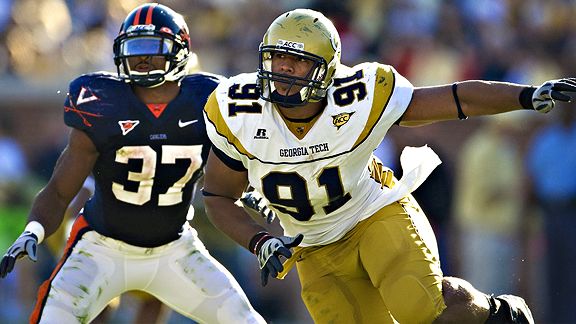
By Kip Earlywine
How about a 2-fer today?
Height: 6'4"
Weight: 270
Unofficial 40: 4.74
Positives:
-Good size
-Great athleticism, acceleration, foot-speed and agility
-Explosive... very explosive by LDE standards
-High Motor, relentless
-Good leverage
-Powerful, can sometimes dominate blockers
-Full pass rush repertoire: edge rush, spin move, slips by with quickness
-Handles double teams well
-Can play both DE spots in a 4-3
-Terrific 2009 stats (18.5 TFL, 12 sacks)
-Edge rush for a LDE is downright scary, which forces a lot of holding penalties from RTs
-Very good awareness, great vs. run
-Good tackler
-No Character concerns, plays hard and seems to be a leader
-No notable injuries
-Well rounded; very few weaknesses
Negatives:
-Mediocre hand use, sometimes can get locked up or struggle to disengage
-Streaky. Gets sacks in bunches
-Not as dominant at RDE
-Pretty much a pure 4-3 player
-Might have issues in coverage
-At his best with a hand on the ground
Sound Bites:
"[Morgan] represents great value because he can rush the passer, is productive against the run and can even drop back -- a versatile talent.
-Mel Kiper jr.
"I bring this up because after one game of the tape review of Georgia Tech defensive end Derrick Morgan [against Clemson]... I had thoughts of grading him above the phenom Ndamukong Suh."
-KC Joyner, ESPN Insider
"Morgan can anchor at the point of attack, make plays in pursuit, get to the quarterback coming off the edge and drop into coverage on zone blitzes. In other words, he can do it all as far as defensive end prospects are concerned. He is a BIG TIME pass rusher."
-Todd McShay
My Thoughts:
I came into this POTD a little biased in Morgan's favor. Despite that, my expectations were exceeded. He's built like a prototypical LDE, but his quickness and moves are like that of a lightweight RDE. Morgan is big, strong AND explosive, which you just don't see everyday. Morgan's quickness is his biggest asset. This probably explains why he's more successful on the left side since RTs are often less equipped to handle a potent edge rush.
Morgan did look pretty ordinary at RDE though. His hand use is just ok and good left tackles can sometimes lock him up. There seems to be some controversy about Morgan's coverage ability. Some like it (Kiper, McShay), some don't (Walterfootball). Morgan is also pretty streaky and likes to pad his stats with big games, but so did Kerney and Tapp in '07.
Morgan played both RDE and LDE in 2009, and has the talent to play both positions in the NFL. However, I think it would be wisest to use him mostly at LDE. Finding very good edge rushers with the size and strength to stop the run is not easy to do. Morgan will make for a special LDE, whereas I think he'd just be ordinary at RDE. Watching those highlights, Morgan reminded me a LOT of a taller, bigger Robert Mathis. That works out well, because I'd rather upgrade over Jackson than Tapp.
Darryl Tapp is an under-appreciated player who impressed Carroll, so I think he'll be back. Tapp is kind of like a poor man's Dwight Freeney. If the Seahawks add a potent DT to pair with Mebane, QB's won't be able to avoid Tapp so much. For as few sacks as Tapp had last year (2.5), he nearly led the league in QB hits (16?). I wouldn't mind at all if the Seahawks complimented a poor man's Freeney with a rich man's Mathis. That duo has been one of the most dominant in the league now for many years in the same style of defense Seattle currently runs.
I think Morgan makes a lot of sense for the Seahawks, and I now feel comfortable taking him at #6. Interestingly enough, when I googled Derrick Morgan Mel Kiper looking for an opinion, the Seahawks were mentioned 5 times on the first page (including this blog). Even if you take out the entries that were due to Kiper giving Seattle Morgan in his 1st mock, there were still about 3 Seahawks sites left. No other NFL team made the 1st page. Morgan is already strongly linked to Seattle and I don't expect that to change any time soon.
I don't know if I'd call Morgan "likely" to be a Seahawk, but I do think he makes a lot of sense. If neither McCoy or Suh falls to #6, and the Seahawks opt to pass on a QB with the first pick, Morgan would probably be my first preference of the remaining options. Matt McGuire compared Morgan to a young Patrick Kerney, and we saw what Kerney did in '07 when he moved to LDE. If the Seahawks draft Morgan and use him correctly, he could become a cornerstone player for Seattle's next playoff bound team.
POTD: Corey Wootton, DE, Northwestern

By Kip Earlywine
Height: 6'7"
Weight: 280
Unofficial 40: 4.83
Positives:
-Big, tall, and strong
-Sometimes decent bull rush, edge rush
-Good tackler
-Hard to move
-Good stats in 2008 (16 TFL, 10 sacks)
-Can play 3-4 end or 4-3 end
-No character concerns, seems like a leader on the field
Negatives:
-Disappeared in 2009 (6 TFL, 4 sacks)
-Slow for a DE, lacks agility too.
-Might be better suited in a 3-4. In a 4-3 he'd be a LDE only
-Mediocre hand use and limited pass rush repertoire
-Will occasionally drop his head or misdiagnose
-Seemed to be dinged up a lot in 2009
My thoughts:
Wootton is a buy low player who should end up drafted in the 2nd or 3rd round. He's a bit of a boom or bust player, as shown by his 2008/2009 stats. I think he's almost certainly better than his '09 stats because he seemed to be suffering from smaller injuries a lot last year. However, I think its meaningful that Wootton pretty much disappeared once he was only 80% or 90%. To me that indicates that he wasn't a truly dominant player when healthy. He'll continue to have injuries from time to time in the NFL, and I'd hate to see him become completely shut down from them.
Wootton to me looks like a classic run stopping DE, and should probably be drafted by a 3-4 team. If he stayed completely healthy and had a best case scenario, he'd only be a little better than Lawrence Jackson, and Jackson is just now shaking off his "entry" years in which DE's typically struggle. So I doubt Wootton would make a lot of sense to the Seahawks, especially since they don't have a 3rd rounder. If he became a star, it wouldn't shock me, but he's risky and doesn't offer the kind of pass rushing upgrade the Seahawks are looking for, so he seems like an unlikely option.
Early combine preview

By Rob Staton
The Scouting combine is just over two weeks away, so it's time to look at some of the prospects who can really help/hurt their stock in Indianapolis. We'll look at more prospects as we get closer to the event, but he's some of the bigger name first round picks who stand to receive a lot of attention from scouts, coaches and personnel.
Dez Bryant (WR, Oklahoma State)
Having missed most of the 2009 season through suspension, teams will first and foremost want to see what kind of shape Bryant's in. It'll be to his massive credit if he shows up with a level of sharpness and it could confirm his place as a top ten pick. If he's treated the last few months as an extended vacation then the opposite could happen. Interviews will uncover whether the suspension was a misfortune or a sign of real immaturity.
Sam Bradford (QB, Oklahoma)
The last time we heard from Bradford was his announcement that he'd take surgery and declare for the draft. Very little has been reported since. At this stage, I'd be surprised if he threw at the combine. He might save that for his pro-day. Nevertheless, teams will be interested to see just how much he actually takes part and what shape he's in physically. He needed to add some weight to that frame in his time off.
Jimmy Clausen (QB, Notre Dame)
We already know Clausen won't throw at the combine because of surgery to his foot. However, you'd still expect him to turn up in Indianapolis - and the stuff he is able to do could be more important anyway. First of all - just how tall is he? Is he at the registered height of around 6'2" (I think he is) or is he a bit shorter as sometimes appears on tape? Secondly - some people have voiced concerns about his personality. Interviews will be so important in proving this is a driving competitive nature and not an over-arrogant ego at work.
Jason Pierre-Paul (DE, USF)
Make absolutely no mistake - JPP is a physical freak. How many times has a prospect shown up at an event like this and stolen the show? He could run a lightning fast time, flash that amazing athleticism and suddenly be a top ten pick on everyone's mock drafts - not just mine. Alternatively, there have been some concerns about his intelligence and dedication to the game. Interviews and the wonderlic will be crucial for the talented, yet raw Pierre-Paul.
Bruce Campbell (OT, Maryland)
The first thing you think of when considering Campbell are those injuries. He absolutely has to prove he's 100% at the combine. Secondly, one coach described him as the offensive line version of Vernon Davis. Essentially - off the charts physically. An explosive performance will impress everyone, but he must know his best chance of going in the top ten is to catch the eye of Al Davis. We know how the Raiders draft by now and Campbell may have the kind of qualities they look for at a position of real need in Oakland.
C.J. Spiller (RB, Clemson)
It's not a great year for running backs, but Spiller is clearly the most intriguing amongst the 2010 class. We know he has speed, the question is - just how quick is he? If he can run a time similar to Darren McFadden a couple of years ago, he could end up being a top ten pick. It's a bit transparent, but team's love guys who run fast forty yard dash times. As soon as you put Spiller in the 'elite' bracket in terms of quickness - his stock rises. It's his challenge to run that eye opening time which he might be capable of.
Sunday, 7 February 2010
POTD: Gerald McCoy, DT, Oklahoma

By Kip Earlywine
Height: 6'4"
Weight: 295
Unofficial 40: 5.01
Positives:
-Very good hand use, disengages blockers seemingly every time
-Some nice pass rush moves
-Very nice size/speed/athleticism (looks faster than Suh to me)
-Great 2009 production
-Very consistent pressure
-Strong
-Good tackler
-A year younger than Suh but put up pretty similar numbers
-Stayed healthy
-Good character/work ethic
-Extremely good upside
Negatives:
-Penetrates the line with his head down, often is completely confused where the ball is
-Tends to lose the battle at the line for the first second before recovering
-Sometimes has leverage issues
-Inconsistent vs. run (frequently struggles to defend his gap)
-He's a 4-3 three tech, and probably nothing else.
Sound Bites:
"McCoy makes his living in the opponents' backfield, and is such a talent he could have landed [at the top few picks of the draft] last year had he declared as a redshirt sophomore."
-Mel Kiper jr.
"McCoy is an amazing prospect and simply great at what he is - a three technique. He has elite intangibles and should be a definite top-10 pick. McCoy is my No. 1 defensive tackle for the 2010 NFL Draft."
-Matt McGuire, Walter Football
My thoughts:
This was the most eye-opening POTD for me to this point. McCoy was in some ways stunningly bad, but made up for it in other areas.
Starting with the bad, within 20 seconds of watching the footage, I noticed McCoy had a big problem with dropping his head when penetrating. Anyone who's played DL will recognize this flaw very quickly, and predictably, this bad habit got McCoy in trouble all game long against BYU. Normally, the ability to penetrate the offensive line is a good thing. It leads to sacks, pressures, TFL's, forced incompletions and turnovers. But when you penetrate with your head down with no awareness of where the ball is, the advancement up the field can actually work against you. It leaves a big hole behind you, and if you don't know where the ball is, the runner will just run right by you and enter the hole you left behind. This happened repeatedly in the BYU game (a critical game that Oklahoma lost). To put it bluntly, McCoy's awareness sucks, and if he struggles this much defending a single gap in a 4-3 one gap principles role, just imagine how much he'd struggle trying to defend two gaps simultaneously as a 3-4 end! And because McCoy isn't overly huge or have good leverage (sometimes losing ground early in the play) to boot, he'd be very unlikely to succeed as a run stuffing one tech. These are probably the reasons why everyone pegs McCoy as a pure 4-3 three technique.
Fortunately, some of those flaws should be fixable with coaching and time. McCoy is a hard worker too, so I'd give him good odds of breaking his bad habits. As long as McCoy isn't a disaster against the run, he'll more than make up for his weakness with his constant disruption in the backfield.
What I really like about McCoy is that he's kind of the anti-Suh but with similar production. Whereas Suh used brute strength to peel defenders off him, McCoy used a combination of arm-dexterity, quickness, skill, and strength to consistently shed blocks in about 1 second. It seems like most snaps, McCoy will lose the 1st second of a block, but dominate the rest of the play. I also like how McCoy has decent looking speed for a DT and has nice pursuit in the backfield. If its a passing play, most downs you can pretty much count to three and by then McCoy will usually be in the QB's face. He may not get the sack, but he'll force the QB to divert attention from downfield and move around in the pocket, often into the arms of one of McCoy's teammates. Like Suh, McCoy is a game changing player in the pass rush. Overall, I think Suh has fewer weaknesses and is more versatile, but if I had my choice between Suh and McCoy, I'd probably pick McCoy because he looks like a perfect fit for a 4-3 pass rushing tackle.
If by some chance the Lions and Bucs are insane enough to not select McCoy and he falls to #6, the Seahawks have to take him. Its nice to dream, but considering that Detroit and Tampa both run 4-3's and list DT near the top of their needs, I just can't see that happening.
Subscribe to:
Posts (Atom)