Tuesday, 16 February 2010

POTD: CJ Spiller, RB, Clemson


By Kip Earlywine

Height: 5'11"
Weight: 195 lbs.
Unofficial 40: 4.34


Positives:

  • Very Fast
  • Great moves, can start/stop and change directions especially well
  • Above average running instincts
  • 2009 was not a fluke, he produced in '08, '07, and '06
  • Plays hurt... plays well hurt
  • Dangerous kick returner
  • Very good outside runner
  • Solid Burst
  • Seems like a leader and has no character issues
  • Career 1 TD per ~20 carries, most of them big plays
  • Reminds me of Reggie Bush as a receiver (that's a huge compliment)

Negatives:

  • Not much untapped potential, size looks maxed out
  • Size/durability probably means he'll continue to be a 150-200 carry RB
  • Not a particularly good inside runner or goal line RB
  • Not especially powerful
  • Supposedly (I've read) is mediocre as a blocker

Sound Bites:
"Spiller is the most electrifying player in college football today."

-Todd McShay

My thoughts:

As always, the POTD series is an incomplete analysis that serves more as a preview than a final word. Spiller is the first RB I've done in this exercise, and I have to say that RB might be the most difficult position to evaluate simply from highlights. Even good sites like prodraftparty show very little pass protection, and we don't see runs where the back missed a hole and settled for 1 yard and a cloud of dust. If it looks like the Seahawks get serious about Spiller, I'll have to get some real game tape of him in a couple months to give a much more accurate opinion.

Anyway, Spiller is an exciting player. Clemson is not a particularly good team, but they were at times a top 25 ranked one during this last season. I firmly believe that without Spiller, they never would have been. Its not very often you see a RB that is the team by himself (like Jake Locker is for UW), and for Spiller to have that kind of impact when averaging only 14.5 carries a game, is ridiculous. He might not carry the ball much, but he chipped in 2.3 catches a game and also returns kickoffs extremely well.

My big concern for Spiller is that like Reggie Bush, he's more of a "kick it outside" runner, and the zone scheme really emphasizes inside running (man does too, just a little less). As an inside runner, Spiller is (edit- reworded) not nearly as potent. And since Seattle's tackles suck and Carlson is a mediocre blocker, I don't see a lot of promise for designed outside rushes (that was an area Seattle really sucked at last year). Bush is a very common comparison to Spiller, and Bush averaged under 4 ypc every year until the Saints made a Superbowl run. Obviously, the Seahawks are very far away from having a Superbowl contending team. Spiller is awesome, and he gives the Seahawks something they badly need as a big play runner and KR, but if the Hawks draft him and he's a dud for us, it wouldn't completely shock me. I don't want to sound too negative though- Spiller is easily the best RB in the draft and I'd probably take him over any RB in last year's draft as well.

Assuming that the Seahawks manage to get the most out of Spiller and he's every bit as dominant in the pros as he was in college, he'd still be seeing less than 20 total touches a game, and how much do you pay for that? Is <20 touches a game worth $8-9 million per year? Probably not. However, at #14, his contract would be much more reasonable, somewhere around $3 million per.

Alex Gibbs turned Davis, Anderson, and Gary into huge stars, and the highest draft pick of the bunch was a 4th rounder. With what looks to be a decently deep RB class, will Seattle invest a big high pick for a RB? Or will they trust Gibbs track record and get a bargain RB later on while spending that pick to grab a WR, DT, or OL instead of Spiller?

Monday, 15 February 2010

Hate mail

By Rob Staton
One of the main reasons I started Seahawks Draft Blog was to interact with fellow Seahawks fans and have a forum where the draft can be debated, reviewed, dissected and discussed. Disagreement is a part of life and I'm not beyond criticism, so I wanted to publish an email I received today:

"Did you personally pick Clausen and a DE?

If so you're a complete idiot and you belong in the Ruskell era.

Not only was Matt killed this year by the pass rush, but our running game sucked and Jones announced his retirement. If you don't think they are taking an O Lineman with one of those top 2 picks, you are beyond lost.

I would strongly consider taking two O lineman if I was Schneider. Thats how important O line is. You get a decent O line, and suddenly Forsett and Matt are total studs, and the whole defense is better because the offense doesnt 3 and out 50% of the time leaving the D breathless.

You don't deserve to have your own Seahawks mock draft blog page. Thats the problem with the internet. Any idiot can post whateevr unsubstantiated claim they want. I just didnt think my Seahawks brothers were part of the problem. Move to San Fran, we don't want you."


I think it's a valid point that clearly the Seahawks offensive line has been a cause for concern ever since the Super Bowl run. Losing the best interior lineman in the NFL in such unusual circumstances was never forgotten during the Ruskell era. More to the point, Hutchinson was never truly replaced. The move from Robbie Tobeck to Chris Spencer has been difficult, largely due to injuries to Spencer but also inconsistent play. This led to the team drafting Max Unger last year and eventually starting him at center.

Replacing Walter Jones was always a pressing concern that became closer with every passing year. That has become a reality now. Sean Locklear has not convinced anyone he deserves to be a permanent feature at left tackle and has missed games through injury himself.

In 2007, Matt Hasselbeck carried the line and the stagnant running game on his back with the best season statistically of his career. In 2008 and 2009, injuries to Hasselbeck and a loss of playmaking options exposed the frailties of the line. One of the first things Pete Carroll did upon accepting the gig in Seattle was to approach Alex Gibbs to be part of his coaching staff - a noticeable appreciation of the situation.

Because of this, as the emailer correctly points out the opportunity to draft an offensive tackle in round one must be considered. However, allow me to point out why this may not be the case also. The first issue is the fact this isn't a great draft for offensive tackles. There are some that will go in round one and some that will go earlier than perhaps they should. Such is the modern NFL and the premium upon the position. What it does mean though is that the quicker tackles leave the board, the greater the possibility the Seahawks end up over drafting. That may be necessary. At the same time, it could be true that 1-2 tackles have left the board before the 6th overall pick and 3-4 by the #14 selection. Do you ignore greater talent elsewhere on a roster with many holes just to fill one specific area?

Secondly, Alex Gibbs-coached teams traditionally haven't drafted lineman early. Houston taking Duane Brown in 2008 is more of an exception than the norm. The need in Seattle might be greater than previous situations Gibbs has faced. What hasn't changed however is his philosophy which favors agile, smaller lineman who can work in a zone blocking scheme. Unfortunately, this isn't a draft filled with that type of offensive tackle.

Anthony Davis isn't an obvious fit for the zone scheme, as I suggested in a scouting report on the Rutgers left tackle back in November. Russell Okung (OT, Oklahoma State) is a more suitable candidate, but I tend to agree with resident scout Kyle Rota's synopsis on the Cowboys lineman. Bryan Bulaga played in a variation of the zone scheme in Iowa. I do believe though that his greatest value at the next level will be as a right tackle. He can play the blind side, but he will be a significantly better pro when he hasn't got to deal with elite edge rushers (he can struggle against speed) and can get some tight end support in the running game. Trent Williams (OT, Oklahoma) is strictly a right tackle and Bruce Campbell (OT, Maryland) owns immense physical qualities - but also a poor injury record.

The most likely candidate for the Gibbs zone blocking scheme would appear to be Charles Brown (my report here) - a prospect familiar to Carroll as he played his college ball at USC. He has the right kind of size (290lbs) and above average ability as a converted tight end. He's a smart player (important in the ZBS) with plenty of starting experience. He has a good hand punch and is a capable pass protector. His size won't interest most teams unless he can get up to the 310lbs range for the combine next week. This could push him into the second round where I projected he would be taken by the Seahawks in my last mock draft.

There are other possibilities too. A prospect like Jason Fox (OT, Miami) would fit the Gibbs mantra and likely be available later on. Selvish Capers (OT, West Virginia) is another name to monitor. Clearly there are options for the new regime if they did want to take advantage of a strong defensive line class in round one or draft the teams future franchise quarterback.

I also believe - and this is merely my own personal opinion - that an offensive line containing first round picks is not a necessity for success. You only have to look at the Super Bowl - two teams that didn't own a cluster of early round picks on their offensive line and both sporting dominant passing attacks. I've voiced many times that whilst the offensive line could do with some investment, an expensive rookie will struggle to block two guys off the edge as much as Sean Locklear. Too often in the last two years a lack of threat at running back, receiver and yes - quarterback - has allowed teams to blitz heavily against the pass and stack the box against the run. They've dared Seattle to beat them and they haven't been able to. At least not against any team not based in St. Louis.

Until Seattle's offense demands respect, it won't receive any. For me, investing in a better offensive line will only lead to long term success if it coincides with better playmakers being brought in at running back and receiver - with a legitimate long term plan at quarterback. That's how you keep a defense honest. For those reasons I think it's unlikely the Seahawks will spend both first round picks on offensive lineman. But I'm not ignorant to the fact it's also a vital need and even despite the appointment of a legendary line coach - one high pick on a future left tackle is absolutely plausible.

Mel Kiper and Todd McShay in the lab

Combine ready: Clausen, Mays, Spiller et al

Sunday, 14 February 2010

Long term vs Short term

By Rob Staton
Long term thinking or a short term shot in the arm? Do you use the 2010 draft to plan ahead or do you use it to enhance what you already have and try to get an immediate boost? Is it a combination of the two or can you not afford to think like this - is it too manufactured when a draft board needs to be respected purely based on BPA? What are the potential pitfalls of either?

Let's say the Seahawks go quarterback and left tackle in round one. This would very much be a long term solution, building an offensive core for tomorrow. However, Pete Carroll's new regime would also be left facing a 2010 season that could potentially be described as a 'lame duck'. A holding position until the rookie's are ready. Current starters at either position would be left holding the fort - and it could lead to disharmony between the present and the future. Even if everyone acted very professional about the situation, you'd be asking the same troops who struggled in 2009 to suddenly produce the goods if you wanted to enjoy a competitive season upon your (Carroll's) return to the NFL.

Of course, even taking that into account, the long term benefit that there's a direction when ageing veterans do retire - is huge. The old adage goes, "fail to prepare and be prepared to fail." The Seahawks have to embrace that the Hasselbeck/Jones/Alexander era will soon be a distant (yet fond) memory. Finding the next batch of franchise players and preparing them sufficiently would likely be welcomed by fans, pundits and coaches alike.

The short term solution doesn't possess that kind of support. It's often seen as the quick-fix. Drafting a running back early has it benefits in that there's a short learning curve - and the Seahawks do need a running back. However, it's unlikely to win you a post season berth consistently if you continue to neglect key positions that may need a year or two to develop and prosper.

Having said that - if the Seahawks want to avoid another bitterly disappointing season in the mold of 2008/2009, they have to find some form of immediate contribution. Whether that's a pass rusher who can finally get to the quarterback, a running back capable of keeping a defense honest or a wide out who gives Matt Hasselbeck a true #1 threat. Transitioning from one era to another needs to be planned with tomorrow in mind - but introducing inexperienced young men into a losing culture is never a good idea.

These are all questions facing Pete Carroll and his new regime. If he were to draft Jimmy Clausen at #6 and Bryan Bulaga at #14, many would rejoice at locking up two key positions for the future (quarterback and offensive tackle). However, would these same fans remain supportive if the Seahawks struggled to another 4-5 win season? What impact would drafting those prospects have on incumbent starters like Matt Hasselbeck and harmony between currents veterans and the younger future?

If the new regime decided to draft Derrick Morgan and C.J. Spiller, some fans would (perhaps correctly) ask where is the long term planning? What is the plan post-Hasselbeck considering his contract year status and age? But would these same fans not appreciate it if the more short term thinking got the new coaching staff up and running on the front foot, creating a platform for younger prospects to brought in perhaps in a better (winning?) culture and atmosphere?

Not that a plan like this was ever likely to be formed, but if you draft one pick for the future and one for tomorrow - do you run the risk of making a token effort that really neither does enough for the future nor enough to win now?

Ultimately decisions will be made based on talent and how the front office set up their draft board. But if there are prospects bunched together of a similar grading, this short or long term thinking could become a discussion point. What do you think the Seahawks have to consider going into this crucial draft for the franchise? Let me know in the comments section.

Saturday, 13 February 2010

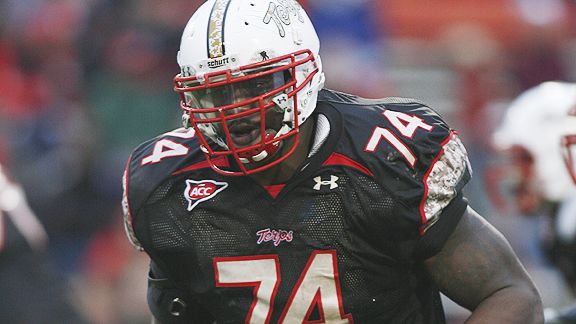
POTD: Bruce Campbell, T, Maryland


By Kip Earlywine

Height: 6'7"
Weight: 310 lbs.
Unofficial 40: 4.94


Positives:

  • Prototypical size (and could add more)
  • Probably the most athletic tackle in the draft
  • Sub-5 40, fast, agile
  • Natural, comfortable, polished, instinctive
  • Does a wonderful job squaring and staying square with pass rushers
  • Above average run blocker
  • Near elite pass blocker
  • Monster Potential
  • Could excel in zone or man
  • No off the field issues that I could find

Negatives:

  • Injuries, injuries, injuries
  • Deceptive footwork? Is a little slow vs. inside moves

Sound bites:


"Consider Bruce Campbell the Jason Smith of the 2010 NFL Draft class. His stock will be soaring through the roof once we get to the Combine, however, he is more of a natural pass protector than Smith."

-Matt McGuire (Walter Football)

"Campbell is just as -- if not more -- adept at guarding the blindside as [Anthony Davis and Trent Williams] and there is every reason to think he could develop into a dominant NFL run blocker."

-KC Joyner, (draft lab series)

My thoughts:

Campbell is my favorite player in the entire draft that I don't want the Seahawks to touch with a 10-foot pole. He's had so many injuries its just ridiculous, in 3 college seasons he only totaled 17 combined starts and 21 total appearances. He did stay healthy in 2008, starting all 13 games, but suffered from turf toe and even an MCL in 2009 and pretty much didn't do anything last year. I've played with two turf toes and two sprained wrists all at once, injuries like those are not to be taken lightly and have a huge impact especially in the running game. Thankfully, they are largely preventable if a player always tapes up before every practice. I think after experiencing turf toe hell, Campbell will probably take more measures to prevent his next one, but the MCL is a bit more concerning. Knee injuries are one of the biggest career destroyers for linemen on both sides of the ball. Once you can't trust your knee anymore, you lose the power to drive block and you are forced to play careful instead of all-out. Campbell may recover from his MCL just fine, but the potential downside makes selecting him in the top 10 a huge risk.

Now that that's out of the way, its really too bad that Campbell has had those injuries, because I loved watching footage of him. He's the best tackle I've previewed so far at squaring his body with the defensive end and keeping the rusher from rushing around or inside him. He's strong enough that bull-rushing him is a waste of time, and he simply won't be beaten outside. His footwork doesn't look that good to me, which is weird considering he's such a freak athlete and is extremely good at staying centered on pass rushers which is much harder than it looks. Sometimes a rusher will make a nice inside move and Campbell almost looks like he's wearing concrete boots. Many experts rave about Campbell's footwork though and I'll definitely say this- I won't argue with the results. If he's that good at staying on top of defenders in pass pro and keeping up on edge rushes, then obviously he's doing something very right.

Campbell is a solidly above average run blocker as well, and usually you don't find tackles that are so good at both pass pro and run blocking.

Campbell's speed and athleticism could make his stock rocket at the combine. He could very well be a top 10 pick. If he had been healthy at Maryland, he'd probably be a lock in the top 5.

For me, he's just too risky. Especially since Gibbs has a penchant for finding good starters much later. But I do like him a lot, and if he stays healthy, I think he has a great chance of being a future pro-bowler.

NFL Network on the draft

By Rob Staton
The NFL Network has shifted some attention to the draft this week, with less than a fortnight until the scouting combine. Mike Mayock, Charles Davis, Michael Lombardi and Jason La Canfora discuss the different positions and what's on offer in this year's class. I've linked to the video clips below:

Top five discussion (Lombardi, La Canfora)
Quarterbacks (Lombardi, Davis)
Running backs (Lombardi, Davis)
Wide receivers (Lombardi, Davis)
Defensive lineman (Mayock)
Linebackers (Lombardi, Davis)
Cornerbacks (Lombardi, La Canfora)
Myron Rolle: Draft Journey

Just a couple of notes: Dexter McCluster is not a wide receiver. When he was played at receiver for Ole Miss in 2009, he struggled badly. His route running is abysmal and it didn't help Jevan Snead early in the year that his best playmaker was being asked to do too much - he isn't going to be a Percy Harvin type like Houston Nutt hoped. When his role was scaled right down to a pure running back, he had a lot of success. I don't think he can do that same role in the NFL at 165lbs, which is why talk of him as a second round pick is way wide of the mark. He's a late rounder for me.

Secondly, Jonathan Dwyer is not a beast.

Friday, 12 February 2010

Guest scouting report: Jimmy Clausen

By Ryan Langermann

Name: Jimmy Clausen
Position: Quarterback
School: Notre Dame
Height:6’2”
Weight: 220lbs

Size
If he measures in at 6'2" or greater, then I am not turned off by his size. He is very durable and shakes off the big hits. Could use a little more bulk, but at this point I would say his body is ready to take on an NFL season.

Arm Strength
Average at worst in the NFL level. He has some good zip on his bubble screens and is able to throw it 50+ yards in the air with decent accuracy. Ball floats when he throws off his back foot and at times doesn’t get enough zip on posts, allowing the safety to make an adjustment.

Accuracy
Short to Intermediate - 69 / 82 completed = 84.15%. I adjusted these numbers to take out dropped balls and throwaways. His short to intermediate accuracy is very good. He gets the ball out very fast on bubble screens and has the zip to throw the ten yard out with consistency. In the games I scouted, the majority of his throws were about 8-10 yard outs. Tends to underthrow his receivers while scrambling to his right and throwing on the move. I have to say that if you put him on a team with inferior WR talent, teams would have played bump and run against his receivers and his favorite route would have been taken away. I am sort of disappointed in the games that I watched because he faced a pretty base defense for the most part (4-2 Nickle, with the nickel CB playing man on the slot receiver.) There were some blitzes from Carroll's elephant linemen and his OLB, but other than stunts, the blitz packages weren't too elaborate.

Deep passes
6/13 completed = 46.15%. Consistent throwing motion, but often times throws the ball too far along the sidelines and doesn’t give his receiver a chance to catch it on go routes. Several times he under threw his receiver when pressure was in his face. Lucky enough for Jimmy, his receivers are good enough to come back to catch the ball (Golden Tate has exceptionally strong hands.) When he has adequate time to set up and transfer his weight from his back to front foot, he most often hits his receiver in stride. When he is pressured, however, he throws off of his back foot and the ball sails and is often times under thrown.

Touch
At times guns it to his backs when it is unnecessary, leading to a few missed first downs. He wants to get the ball out of his hands in a hurry, but I didn't see a lot of touch in his swing routes and RB screens. They are accurate, but often times too hard. He didn’t throw too many posts and seam routes during the games I scouted, so I didn’t get to see his touch as much as I had hoped. I was expecting more seam routes to Rudolph (TE), but didn't catch any in the games I scouted.

Set Up
Consistent drop backs. 3 – 5 – 7- 9 steps all look good and are very consistent. Keeps eyes downfield while dropping. Always keeps his feet and hips lined up with his eyes while going through progressions, allowing him to start his throwing motion as quick as he makes his reads.

Delivery
¾ delivery, but is very quick. When throwing deep ball, drops his throwing shoulder well and throws a consistent ball. Delivery slows down while throwing deep ball, but he throws a very catchable ball with good air underneath it when he intends to do so. I'm fine with his 3/4 delivery and only one of his passes was tipped at the line of scrimmage (although most of his throws were outside of the hashes.)

Release
Has an extremely quick release on short to intermediate throws. This would be his biggest strength if he were to be drafted by a WCO team. I did notice that he takes a bit longer to throw bubble screens to his right and isn’t as accurate as he is throwing to his left on these routes.

Running ability
Doesn’t have plus speed as a quarterback, but is agile in the pocket and isn’t afraid to tuck the ball and go when there is nobody open. Recognizes where the first down marker is and is willing to dive for it. Shows a good slide when he has the first down.

Pocket Presence
Jimmy stands calmly in the pocket and doesn’t panic when pressure is coming at him. He has a good feel for pressure coming from his back side, but in a forth quarter vs. Stanford he held on to the ball too long and took a costly sack. He may try to do too much in the forth quarter, but he does know when to throw it out of bounds the majority of the time. His great mechanics tend to break down when a DT is running straight at him.

Poise
Very calm demeanor under pressure, but is fiery when he needs to be. He gets everyone lined up correctly and points out blitzers if he recognizes them pre-snap. Led several 4th quarter comebacks this year and never looked fazed. You could only tell he was hurt after the play, when he was limping. Very gutsy.

Decision Making
Very efficient passer that doesn’t often take risks. On a couple of plays (one in particular against Stanford, backed up on his five yard line) he has thrown the ball deep off of his back foot into multiple coverage and has been lucky not to have the ball picked off. He shows great awareness late in games in the routes he chooses to throw to. Knows where the sticks are. Very smart player and is willing to throw the ball away when he feels extreme pressure. He threw the ball away in his own endzone while outside of the tackle box, but he didn’t get the ball past the line of scrimmage. He was turned sideways, but this could be an indicator that without his good mechanics, his arm isn’t very strong.

Locating Receivers
Makes progressions quickly. He seems to lock onto certain routes more so than receivers, as I expected him to start out by looking for Golden Tate immediately. This could be a concern that he makes some decisions pre-snap, which I have heard some people complain about regarding him. He knows his hot routes and locates and diagnoses blitzes quickly. Often times he waits too long to throw a curl or out route. In the NFL he will need to get the ball out quicker on these types of routes. He rarely threw the ball before the receiver made his cut. To his defense, there was enough separation and none of the balls were batted down on curl routes, but he needs to decide quicker because in the NFL, the DB closes the gap much quicker.

Leadership
Keeps calm while play clock is winding down. Makes sure everyone is lined up right. Leads his team by example and plays through injury. It is hard to get a feel for his leadership in only a handful of games, but from what I have heard he is a good leader.

Toughness
Played with a turf toe for the majority of the year. He is a fiery competitor with the respect of his teammates. Shows willingness to take the big hit on quarterback sneaks. Keeps legs churning. There was one double reverse where Clausen was out in front of the runner and chose not to throw a block downfield, which was disappointing.

Misc
Fumbled snap on counter play. Brought body back too fast and never had a good hold on the ball. He can get anxious on quick handoffs, but for the most part his handoffs were clean and where they needed to be. Good pump fakes to set up screens to opposite side of field. VERY good at improvisation. Sets up screens very well. Sells play action well.

Summary
I think Clausen fits any system but his quick release would make him a good fit for a WCO. He makes decisions quickly. I didn't see him look off safeties, which was a concern. He only pump faked once and that was on a wheel route. His mechanics are very good and his delivery (while 3/4) is consistent and very quick. I wish I would have seen him throw more seam routes and tested the consistent cover-2's that the defenses were showing him. It is hard to project him to a Bates offense, but from what I have seen out of Bates, he projects well. I think he can make all of the throws, but he has a few mechanical issues with his deep ball and doesn't do a lot of the little things such as looking off safeties. He does sell play-action very well and has tremendous improvisation skills. He goes through his progressions and takes what the defense gives him. He doesn't create very much for himself unless a play breaks down and he finds away to avoid the rush.

Thursday, 11 February 2010

POTD: Eric Berry, S, Tennessee


By Kip Earlywine

Height: 5'11"
Weight: 195
Unofficial 40: 4.36


Positives:

-Fast, recovers quickly
-Good in coverage
-Very good running instincts with the ball in his hands
-Has a very special knack for finding the ball and breaking on it
-Good hands
-Shows very impressive athleticism
-Highly productive
-Seems like a leader on the field, no character issues
-Plays through pain well
-Plays hard- sometimes can lay big hits

Negatives:

-Left shoulder held up in '09 but still needs to be looked into
-Was a lot less effective in Kiffin's zone coverage system
-Has a bad habit of dive tackling too much
-Occasionally has mental lapses against the run
-Inconsistent tackler
-Sometimes goes for the big hit instead of a solid tackle

Sound Bites:

"Safeties typically aren't top-10 picks. They're rare. The question is, is Berry rare? He probably is."

-Mike Mayock

"Berry is one of those few individuals where it just seems like this is what he was born to do. He is a natural on the football field with the intangibles to boot."
-Matt McGuire (Walter Football)

My thoughts:

Berry was a fun player to watch, and is a deserving college megastar. Safeties tend to make the jump to the NFL as well as any position, which explains why it has one of the lowest bust rates.

The issue then, is Berry worth drafting in the top 10, or at #6 specifically? Many people, including pretty much every big shot draft analyst, has called Berry the next Ed Reed. The only problem is, he'd need to be as good as Ed Reed to justify the pick. Ed Reed is one of the highest paid safeties in the league, currently on a 6 year, $40 million contract. If the Seahawks drafted Berry #6, you could expect him to get a contract for 5-6 years at $40-$45 million (the last #6 pick signed for 6/42 and the guy before him signed for 5/40). If the Seahawks draft Berry, they'll be paying him for an Ed Reed level performance, maybe even a little more. Sure, anyone they draft at #6 will get a $40-$50 million contract, but certain positions, like DE, DT, CB, or QB, would have a higher likelihood of becoming a good value contract as those positions can be very valuable.

Then you have to ask if a team with as many needs as Seattle can afford to take a low impact position player with such a rare pick.

I do think Berry could make sense as a top 10 pick if a team with fewer needs trades up. For example, the Giants won the Superbowl only a couple years ago and don't have a lot of holes. They pick 15th and badly need a safety. I could see them at least potentially trading up for Berry. But I have a hard time justifying giving Berry such a big contract to any "needy" team, which is pretty much everyone in the top 10.

As far as what I saw of Berry on tape; it was a little inconclusive and I actually left out some highlight videos because they gave me a vibe of "cherry picking" even more than usual. All of these POTD's should be taken with a grain of salt, but this one probably deserves an extra portion.

What I noticed is that Berry is a very fun player to watch (he plays very hard) and the hype about his ball hawking ability is 100% justified. He really does have the "aura" of a future NFL star. I get why some pundits even have him in the top 3. He is a real natural in man coverage and has a wily tendency to allow his WR a cushion to bait the QB, then burst on the ball forcing interceptions. Most interceptions are simply mistakes that a defender capitalizes on. Berry deceives QBs and forces mistakes. Its pretty awesome to watch. Not many guys can do that.

Berry is also special with the ball in his hands. He's a huge pick-6 threat, and could probably make a good returner in the NFL. I don't know if he got the record or not, but late in the '09 season, he was very close to breaking the all time interception return yardage record.

I value pass defense much higher than run stopping, but I'd say that the ability to stop the run is not a strength for Berry. He sometimes has mental lapses and shows poor run stopping instincts. He has a bad habit of diving for runners when he doesn't need to- and this usually results in a missed tackle. Without sounding too critical, it was downright Brian Russell like at times. Like Russell, Berry will sometimes sacrifice a sound defensive strategy in favor of a high risk, high effort attempt to make a play in the run game. Also like Russell, Berry loves laying out big hits instead of wrapping up (I like big hits, but they are situational, like trying to lay a big hit right as the ball arrives. Big hits aren't as smart vs. the run in an open field). And like Russell, Berry will sometimes dive late on a pile just because he's so amped. Of course, Russell was awful in coverage so that's mercifully where the similarities end. Berry does sometimes make nice tackles and he's always giving 110% effort. I just wish that like Aaron Curry, he'd tone it down a tad and try to play a little smarter instead. From what I saw, I'd judge Berry below average in run support with the potential to improve to the point where he could be above average if he is well coached.

Perhaps the biggest issue with Berry as a potential Seahawk is that Berry suffered from Monte Kiffin's Tampa 2/zone system in 2009. Once Berry was limited to a certain section of the field, opposing QBs just avoided his zone and that really hurt Berry's numbers. Of course, there is something to be said about a defender who never gets challenged. One other problem is that Seattle's pass rush is so crappy that Berry won't get a lot of hurried throws to turn into picks.

Seattle could use an upgrade at safety, but Berry is a bit of a luxury pick given the needs at QB, WR, RB, OL, DT, DE, and CB. I probably wouldn't take Berry at #6, although his presence there might entice a trade. At #14, I'd probably consider Berry though. He'd be at a much better contract there and is a safe, pro-bowl caliber talent.